
The Quiet Revolution: How Art Therapy Is Finding Its Way Into Everyday Communities
How a quiet wave of color and canvas is breaking down mental health barriers, turning local neighborhoods into healing spaces.
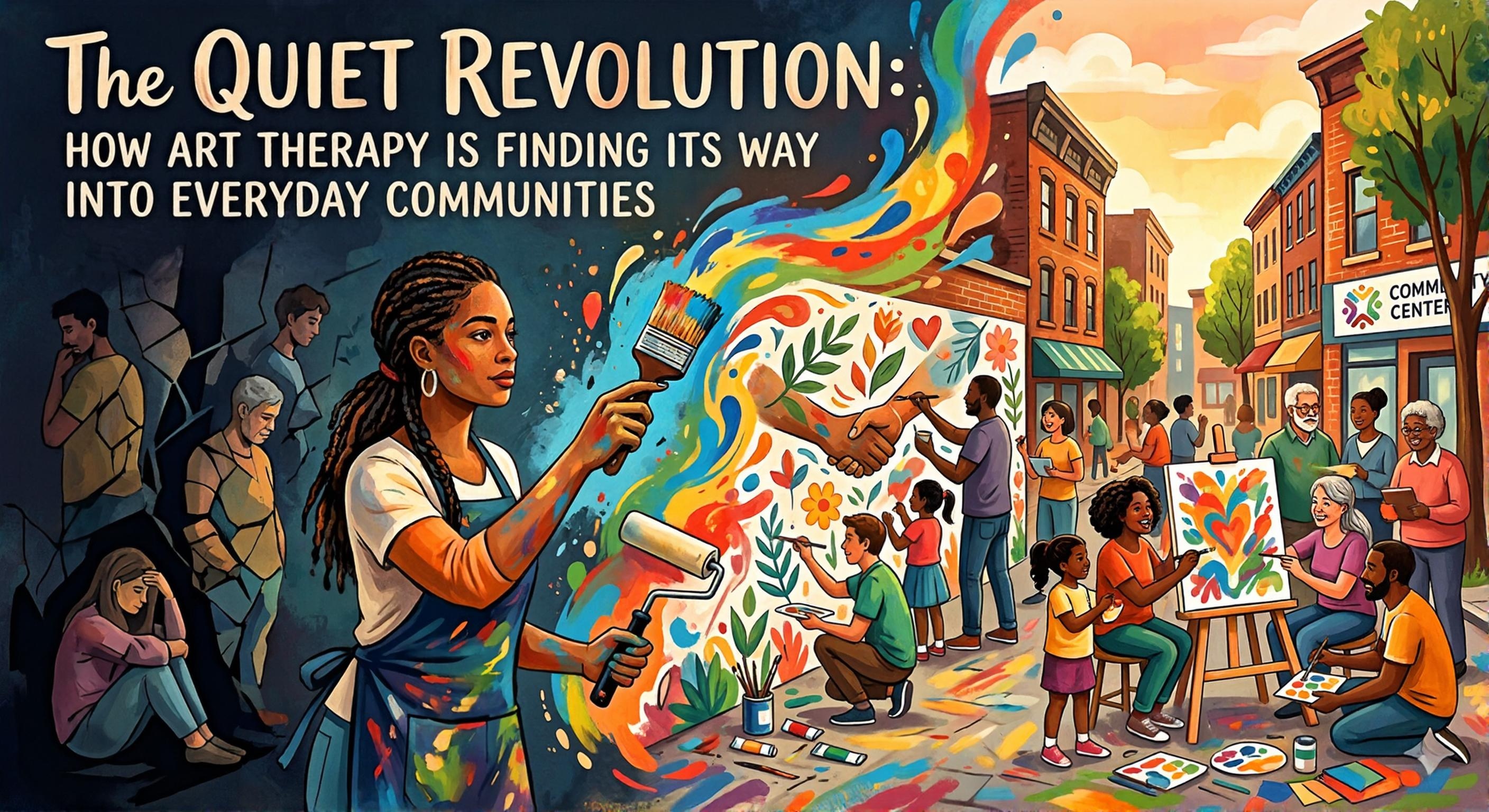
I want to start with a confession: I didn't come to this work through a textbook. I came to it through grief. Two years ago, I lost both of my parents within a few short months of each other, and not long after, I lost the job that had quietly been costing me more than a paycheck. The version of me that had always powered through everything finally set her brushes down and asked, now what?
I didn't have an answer. But I had paper. I had paint. I had hands that needed somewhere to put all of it. So I made marks — ugly ones, honest ones, ones I didn't show anyone — and slowly, the noise inside me started to take a shape I could actually look at. That's when I understood, in my body and not just my head, why art therapy is having a quiet moment in communities all over the country.
I should be clear about who I am and who I'm not. I'm a certified Art Therapy Practitioner, not a licensed clinical therapist, psychologist, or medical doctor. I can't diagnose anything, and I'm not here to replace the very real, very necessary work of clinicians. What I offer — and what so many practitioners like me offer — is something adjacent: a creative, trauma-informed, supportive space where art becomes the language for what's hard to say out loud.
Why is this spreading A decade ago, art therapy mostly lived inside hospitals, inpatient programs, and university clinics. Today, you'll find it in community centers, veterans' groups, hospice programs, schools, and increasingly, in living rooms — mine included, since I work with clients in-home and over Zoom. Part of this growth comes from a simple cultural shift: more people are willing to admit that talk isn't always the easiest entry point into their own feelings. Sometimes the body and the hands know things before the mouth does. Communities are also catching on to the fact that this work doesn't require insurance approval or a clinical diagnosis to be valuable. It's accessible in a different way — private-pay, low-barrier, and built around curiosity rather than crisis. You don't have to be "good at art." You don't even have to know what you're trying to express. You just have to be willing to make a mark and see what it tells you.
What it actually looks like A session isn't a critique of your drawing. There's no grading, no "right" way to hold a paintbrush. It might look like color sorting when words feel too heavy, or building a collage around a memory you haven't been able to talk about yet. It might be quiet. It might be messy. The materials are guided, the pace is yours, and the goal is simply to let something that's been stuck move. This is where I think the deeper insight lives: creativity isn't a luxury add-on to healing — it's one of the oldest, most human ways we've ever processed pain. Long before "self-care" was a marketing term, people were painting on cave walls, weaving grief into textiles, and singing laments. We're not inventing something new. We're remembering something old.
A path through life's challenges I've watched people walk in carrying years of unspoken loss, anxiety, burnout, or simply the exhaustion of holding it together for everyone else — and walk out lighter, not because the problem disappeared, but because they found a way to externalize it. To put it on paper instead of carrying it silently in the body. That externalizing is powerful. It gives you something to look at, to turn over, to ask questions of, instead of something that just sits inside you growing heavier. If you've been wondering whether this kind of work is "for you" — whether you're too skeptical, too unartistic, too busy, too guarded — I'd gently say: you don't have to know yet. You just have to be curious enough to try. I write more about this journey, the unraveling that led me here, and the practice of using art as a soul-language in my book, The Soul's Palette. And if you'd like to learn more about how sessions work, I'd love to have you visit my practice, Human Thread Studios, at humanthreadarts.com, where you can also book a free, no-pressure discovery call.
Wherever you are in your own story — grieving, stretched thin, simply curious — there is room here for you to begin again, on any ordinary Tuesday, with whatever you have in front of you.
— Kay Kelison, Certified Art Therapy Practitioner